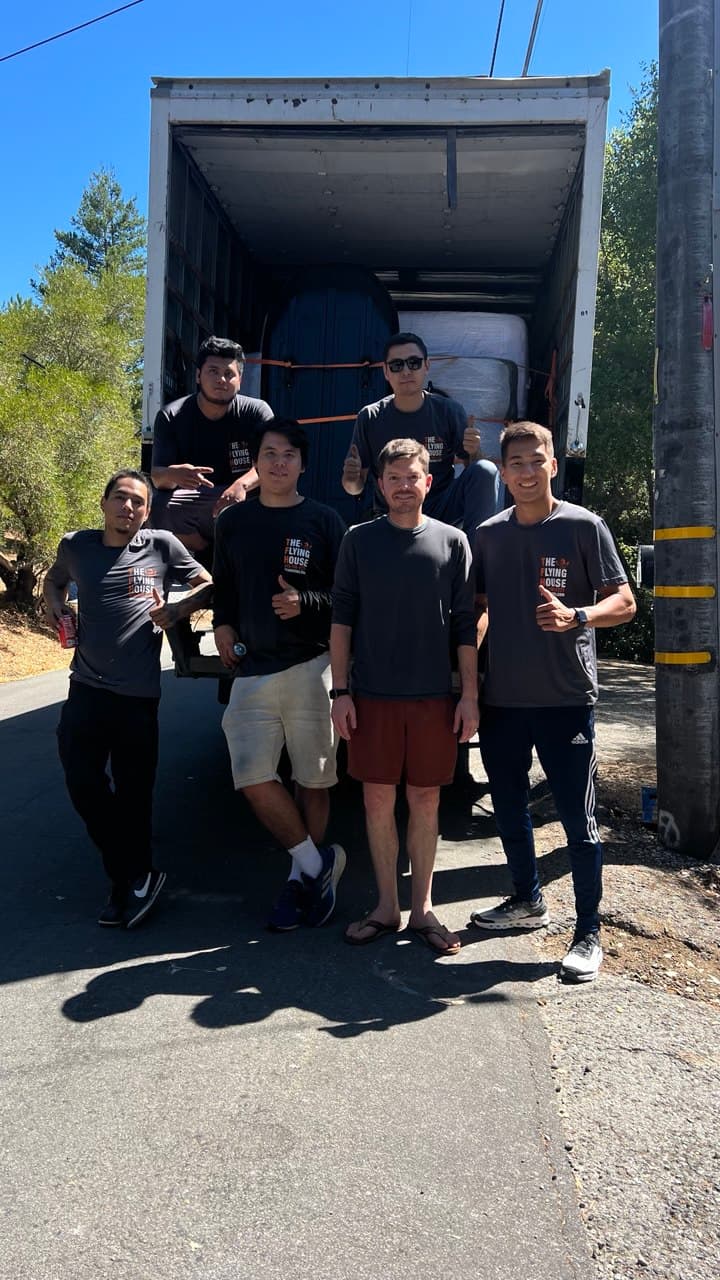
Last month I moved a 900-pound Liberty Colonial gun safe from a second-floor bedroom in a Fremont ranch house to a ground-floor office in a new construction home in Dublin. The client had bought the safe fifteen years ago and had it installed before the staircase railing went in. Now he was staring at a 36-inch-wide safe and a 32-inch stairwell opening. We ended up removing the door frame, pulling the banister temporarily, and using a four-man crew with a motorized stair climber. The move took six hours, but the safe arrived without a scratch and the client's floors stayed intact.
I'm David, Head of Operations at The Flying House, and I've been moving gun safes across the Bay Area since 2019. I've handled everything from 300-pound stack-on cabinets in San Jose apartments to 1,200-pound Fort Knox vaults in Palo Alto estates. Gun safe moving isn't about muscle alone — it's about physics, equipment, and knowing when a doorway absolutely won't work without modification.
This guide covers the technical details I walk through with every client before we touch a safe: weight verification, equipment requirements, clearance measurements, crew protocols, and cost expectations for 2026. If you're planning a move and you've got a gun safe, read this before you do anything else.
Weight and Dimensions: Know What You're Actually Moving
The first question I ask is always the same: what's the model number? Most clients guess their safe weighs "maybe 500 pounds" when it's actually 850. I've seen Liberty Presidentials that hit 1,100 pounds empty, and once you add firearms, ammunition, and documents, you're pushing 1,300. That's not a two-man job with a furniture dolly — that's a specialty move with dedicated equipment.
As of 2026, the most common residential gun safes I move in the Bay Area fall into three weight classes: light-duty stack-ons and compact safes (200-400 pounds), mid-range residential models like Liberty Centurion or Champion (500-800 pounds), and heavy-duty vaults from Fort Knox, Browning, or AMSEC (900-1,400 pounds). Each class requires different equipment and crew size.
I tell every client to find the manufacturer's spec sheet. If you don't have it, look up the model online — Liberty, Fort Knox, and AMSEC all publish exact weights and exterior dimensions. I need the height, width, depth, and empty weight. Then I add 15-20% for contents unless you're emptying it completely, which I recommend for anything over 700 pounds going up or down stairs.
Exterior dimensions matter as much as weight. A safe that's 60 inches tall and 30 inches wide won't make a turn in a standard Bay Area hallway without tilting, and tilting a 900-pound safe on carpet with low ceilings is how you punch holes in drywall. I measure doorways, hallways, and stairwells before we commit to a move plan.
Equipment Requirements: What It Actually Takes
For safes under 400 pounds on a single level, we use a heavy-duty appliance dolly, moving straps, and furniture sliders. That's standard equipment my crew carries on every residential move. For anything heavier or involving stairs, we bring specialized gear.
The motorized stair climber is the key tool for safes over 600 pounds on stairs. It's a battery-powered track system that distributes weight and climbs one step at a time. We own two models — a lighter unit for safes up to 750 pounds and a heavy-duty Zonzini that handles up to 1,500. The climb rate is slow — roughly one step every 8-10 seconds — but it's controlled and it saves your floors, your walls, and my crew's backs.
We also carry 4-inch lifting straps rated for 2,000 pounds, a pry bar set for leveling and shimming, heavy-duty furniture blankets (not the cheap kind that slide), and polyethylene floor runners. For hardwood or tile, I lay runners from the safe's starting point to the truck. For carpet, we use plywood sheets on stairs to create a stable ramp surface for the climber.
On jobs where we know the safe is going to a basement or second floor in a home with tight clearances, I'll bring a come-along winch and rigging straps. I've used it twice in the past year — once in a Noe Valley Victorian with a 28-inch basement stairwell, and once in a Los Gatos hillside home where the only access to the lower level was an exterior stone staircase with no railing.
Measuring Clearances: The Math That Matters
This is where most DIY gun safe moves fail. You can't eyeball a 30-inch safe and a 32-inch doorway and assume it'll fit. You need to account for the dolly width, the tilt angle, and your crew's hand clearance on both sides. I measure everything twice and I add a 3-inch margin.
Start with doorways. Measure the narrowest point of the door frame — usually the strike plate side. Then measure your safe's widest point, which is often the door handle or locking bolts, not the body. If the difference is less than 4 inches, we're removing the door frame trim or, in some cases, the entire door and frame temporarily. I've done that on six moves in the past year, mostly in older Bay Area homes with 30-inch bedroom doors.
Stairwells are more complex. I measure the width at the narrowest point — usually where the handrail is mounted. Then I measure the vertical clearance from the nose of each step to the ceiling or landing above. For a safe that's 60 inches tall, you need at least 66 inches of vertical clearance when it's tilted on the dolly, or it'll hit the ceiling on the turn.
I also check for 90-degree turns and landings. A standard Bay Area home built after 1990 usually has a 36-inch stairwell with a 42-inch landing. That's workable for most safes up to 30 inches wide. Older homes — especially in San Francisco, Oakland, and Berkeley — often have 32-inch stairwells with no landing, just a straight run. Those require either a full disassembly (removing the door and pulling the bolt mechanism) or an exterior crane move, which I'll cover below.
Crew Size and Protocols: How We Actually Move It
I don't send a two-man crew to move a gun safe unless it's under 300 pounds and staying on the same floor. For most residential gun safe moves in the Bay Area, I send a three- or four-man team, and I'm on-site as the lead.
Here's the standard protocol: we walk the route first, measuring and marking pivot points. We remove all obstacles — furniture, rugs, wall art, anything within 4 feet of the path. We lay floor protection from the safe to the truck. Then we assess the safe's center of gravity by tilting it slightly. A safe that's front-heavy (most are, because of the door) gets strapped differently than one with rear-mounted bolts.
For a typical 700-pound safe going down a flight of stairs, we position the stair climber at the top, strap the safe to the climber with two 4-inch straps, and run a safety tether to a fixed anchor point (usually a structural post or heavy furniture we've verified can hold the load). One crew member operates the climber controls, two crew members guide the safe from the sides, and I'm at the bottom of the stairs managing the landing zone.
We move in 15-minute intervals with 5-minute breaks. Gun safe moving is slow work. A 900-pound safe going from a second-floor bedroom to a truck parked in the driveway typically takes 90 minutes to two hours for the load alone, not counting the drive and unload. I tell clients to expect a half-day minimum for any safe over 600 pounds involving stairs.

🔐 Moving a gun safe or other heavy specialty item? My crew handles safes up to 1,500 pounds with the right equipment and protocols. We serve the entire Bay Area with residential moving services that include specialty items. Call (510) 999-7233 or get your free quote here.
When to Remove the Door (and How)
If your safe is over 700 pounds and you're moving it up or down stairs, I almost always recommend removing the door. A Liberty Presidential's door weighs roughly 200-250 pounds by itself. Removing it cuts the total weight by 20-30%, which changes the equipment we need and reduces the risk of a tip or a wall strike.
Most residential gun safes have a removable door. You open it to 90 degrees, locate the hinge pins (usually two or three), and drive them out with a punch and hammer. The door lifts off. We wrap it separately, move it separately, and reinstall it after the body is in place. The process adds about 30 minutes to the total job time, but it's worth it.
Some safes — particularly older models or commercial-grade vaults — have welded or non-removable doors. In those cases, we're moving the full weight. I've moved a few AMSEC vaults in Palo Alto and Los Altos that were over 1,000 pounds with the door on, and those required a four-man crew, a heavy-duty stair climber, and a very slow descent.
One note: if your safe has an electronic lock, removing the door can sometimes reset the lock or trigger a lockout if the battery is low. I tell clients to verify the lock is working and the battery is fresh before we start. I've had two jobs where the client couldn't get the safe open after reinstalling the door, and we had to call a locksmith. That's a $200-$400 service call as of 2026, and it's avoidable.
Crane and Exterior Moves: When the Interior Route Won't Work
I've done three crane moves for gun safes in the past two years. All three were in older Bay Area homes with stairwells under 32 inches and no feasible way to remove enough framing to get the safe through. In those cases, we bring in a small crane or a boom truck, remove a window, and lift the safe to or from the second floor.
A crane move costs more — typically $800 to $1,500 for the crane rental and operator as of 2026, plus our crew time. But it's faster and, in some cases, safer than trying to force a 900-pound safe down a stairwell that's 2 inches too narrow. I've done this in San Francisco's Outer Sunset, in a Berkeley hills home, and once in a Sausalito hillside property where the only access was a steep outdoor staircase.
The process: we schedule the crane for a 2-hour window, usually early morning to avoid traffic and parking issues. We remove the window and frame (we reinstall it afterward), rig the safe with lifting straps rated for twice the safe's weight, and guide it out or in. The crane operator does the lifting; my crew does the rigging and positioning. It sounds dramatic, but it's a standard process for commercial HVAC and equipment moves, and it works just as well for gun safes.
One thing to note: if you're in a neighborhood with narrow streets or limited crane access — parts of Oakland, San Francisco, or older San Jose neighborhoods — you may need a parking permit or a temporary street closure. I handle that coordination, but it adds a week to the scheduling process.
Cost Expectations for Gun Safe Moving in 2026
I get asked about cost on every estimate call. The answer depends on weight, distance, stairs, and equipment. At The Flying House, we work on transparent hourly pricing with flat-rate options available after a free on-site walkthrough. For gun safe moves, I almost always recommend the walkthrough, because the variables matter.
As of 2026, a typical gun safe move within the Bay Area breaks down like this: a 400-pound safe on a single level with no stairs runs roughly $300 to $500, depending on drive time and access. A 700-pound safe going up or down one flight of stairs with a stair climber typically runs $600 to $900. A 1,000-pound safe requiring door removal, a four-man crew, and a stair climber is usually $1,000 to $1,400. Add a crane move and you're looking at $1,800 to $2,500 total.
We include all equipment in the quote — dollies, climbers, straps, floor protection, blankets. We don't charge extra for door removal or reassembly. If we need to remove a door frame or window casing, I'll note that in the estimate, and we reinstall it as part of the job. The only additional cost is if you need a crane, which we coordinate but bill separately since it's a third-party rental.
One of our key differentiators: we use dedicated trucks — your safe is never consolidated with another client's load. You get the same in-house crew from load to unload, which matters when you're moving a $3,000 gun safe with $10,000 worth of firearms inside. I've heard stories of other companies subcontracting the heavy lifting to day laborers who've never touched a safe before. We don't do that.
Insurance, Liability, and Firearms Regulations
This comes up on every gun safe move: what happens if the safe gets damaged, and what do I need to know about transporting firearms? Let me address both.
First, the safe itself. We carry full liability insurance and we're licensed under USDOT 3638952 and CAL-T 192722. If we damage your safe during the move, we cover the repair or replacement. That said, gun safes are built to take a beating — I've never seen one crack or fail structurally during a move. The damage risk is usually cosmetic: scratches on the powder coat, dents on corners, or dings on the door. We wrap every safe in heavy-duty blankets and use corner guards, but if you've got a show-quality safe with a custom finish, let me know up front and we'll add extra padding.
Second, firearms. I'm not a firearms dealer and I'm not licensed to transport guns. California law requires that firearms be stored unloaded and locked during transport, and the easiest way to comply is to keep them in the safe. If the safe is locked and we're moving it as a sealed unit, that's legal. If you're removing the door for weight reduction, you'll need to remove the firearms first and transport them separately in a locked case in your own vehicle, or have them transferred through an FFL if you're moving long-distance out of state.
I always tell clients: I don't need to know what's in the safe, but I do need to know the total weight so I can bring the right equipment. If you've got 500 rounds of ammunition and a dozen rifles inside, that's an extra 100-150 pounds. It matters for crew size and equipment.
Common Mistakes I See (and How to Avoid Them)
The biggest mistake is assuming a gun safe move is just like moving a refrigerator. It's not. Refrigerators have handles and a low center of gravity. Gun safes are top-heavy, have no good grip points, and will tip forward if you tilt them wrong. I've been called to finish jobs that other movers started and abandoned because they didn't have the right equipment or they underestimated the weight.
Second mistake: not measuring. I've shown up to jobs where the client swore the safe would fit through the hallway, and it didn't. We ended up removing a door frame, which added 90 minutes to the job. Measure everything, add a margin, and call me if you're not sure.
Third mistake: trying to save money by hiring a cheap crew off Craigslist. I've seen the aftermath — damaged floors, cracked drywall, and one case where a 600-pound safe fell halfway down a staircase and punched a hole through the landing. Gun safe moving requires experience, equipment, and insurance. If a mover quotes you half what everyone else is quoting, there's a reason.
Fourth: not emptying the safe. If you're moving a 700-pound safe down stairs and it's got another 200 pounds of contents inside, you're at 900 pounds total. That changes the equipment and the crew size. I'd rather move a 700-pound empty safe and have you transport the contents separately than risk a tip on a staircase because we didn't account for the extra weight.
What to Expect on Moving Day
I arrive 15 minutes before the crew to walk the route one more time and verify access. If you're in a building with an elevator, I'll check the weight limit — most Bay Area residential elevators are rated for 2,000 to 2,500 pounds, which is fine for a gun safe plus crew, but I've been in older buildings in San Francisco where the limit is 1,500 and we've had to make two trips (safe first, crew second).
The crew shows up with the truck, equipment, and floor protection. We lay runners, position the dolly or climber, and strap the safe. If we're removing the door, we do that first. Then we move in slow, controlled intervals. I'm calling out clearances and pivot points. The crew is watching for wall strikes and floor snags. It's methodical.
Once the safe is on the truck, we secure it with ratchet straps to the truck's D-rings. It doesn't move during transport. At the destination, we reverse the process — unload, position, reassemble the door if needed, and level the safe. Most gun safes need to be leveled so the door closes properly. We carry shims and a 4-foot level for that.
Total time for a typical 700-pound safe moving from a second-floor bedroom in Fremont to a first-floor office in San Jose: about 4 to 5 hours, including drive time. Longer if there are access issues or if we're doing a crane move.
Settling In: Reinstalling and Anchoring Your Safe
Once the safe is in position, most clients ask whether they should bolt it down. California doesn't require it by law for residential gun safes, but I recommend it if you're in an earthquake zone (which is everywhere in the Bay Area) or if the safe is over 500 pounds and you've got kids in the house.
We don't do the anchoring ourselves — that's outside our scope and it requires drilling into your foundation or floor joists — but I can walk you through what's involved. Most gun safes have pre-drilled anchor holes in the bottom or back. You'll need concrete anchors if you're bolting to a slab, or lag bolts if you're anchoring to a wood subfloor. A handyman or general contractor can do it in about an hour for $150 to $250 as of 2026.
If you're placing the safe on a second floor, check the floor's load rating first. A 900-pound safe concentrated on a 2-square-foot footprint is roughly 450 pounds per square foot. Most modern Bay Area homes are built to handle 40-50 pounds per square foot for live loads, but that's distributed weight. A point load like a gun safe can stress floor joists, especially in older homes. I've seen sagging floors in a few older Oakland and Berkeley homes where a safe sat in the same spot for a decade. If you're concerned, have a structural engineer take a look before we place it.
FAQ
Can I move a gun safe myself with a few friends?
I don't recommend it unless the safe is under 300 pounds and you're staying on the same level with no stairs. Anything heavier or involving stairs requires specialized equipment — a motorized stair climber, heavy-duty straps, and a crew that knows how to manage the center of gravity. I've been called to finish DIY moves that went wrong, and the repair costs for damaged floors and walls usually exceed what a professional move would've cost.
How much does it cost to move a gun safe in the Bay Area in 2026?
It depends on weight, stairs, and access. A 400-pound safe on a single level typically runs $300 to $500. A 700-pound safe with one flight of stairs is usually $600 to $900. A 1,000-pound safe requiring a four-man crew and stair climber runs $1,000 to $1,400. Add a crane move for tight access and you're looking at $1,800 to $2,500 total. We offer transparent hourly pricing with flat-rate options after a free walkthrough.
Do I need to empty my gun safe before moving it?
I recommend it for anything over 700 pounds, especially if you're going up or down stairs. The contents add weight — ammunition, firearms, and documents can add 100 to 200 pounds — and that changes the equipment and crew size we need. Also, California law requires firearms to be stored unloaded and locked during transport, so if we're removing the safe's door for weight reduction, you'll need to transport the firearms separately in your own vehicle.
What equipment do you use to move gun safes?
For safes under 400 pounds on a single level, we use a heavy-duty appliance dolly and furniture sliders. For safes over 600 pounds or involving stairs, we bring a motorized stair climber, 4-inch lifting straps rated for 2,000 pounds, floor runners, and heavy-duty blankets. For safes over 1,000 pounds or homes with very tight access, we'll coordinate a crane move, which involves a boom truck and rigging straps.
How long does a gun safe move take?
A single-level move with no stairs typically takes 2 to 3 hours total, including load, transport, and unload. A move involving one flight of stairs with a stair climber usually takes 4 to 5 hours. A complex move with door removal, multiple flights, or a crane can take 6 to 8 hours. I always schedule gun safe moves as dedicated jobs — we don't combine them with other moves on the same day.
Can you move a gun safe in an apartment building with an elevator?
Yes, as long as the elevator is rated for the weight. Most modern Bay Area residential elevators handle 2,000 to 2,500 pounds, which is fine for a gun safe plus a two-man crew. I verify the weight limit before we schedule the move. If the elevator is too small or the weight limit is too low, we'll use the stairs with a climber or, in rare cases, coordinate a crane move from an exterior window.
Ready to move your gun safe safely and efficiently? The Flying House serves the entire Bay Area with residential moving services that include specialty items like gun safes, pianos, and heavy equipment. Call (510) 999-7233, email tfhmoving@gmail.com, or get your free quote here. Licensed and insured — USDOT 3638952 · CAL-T 192722.